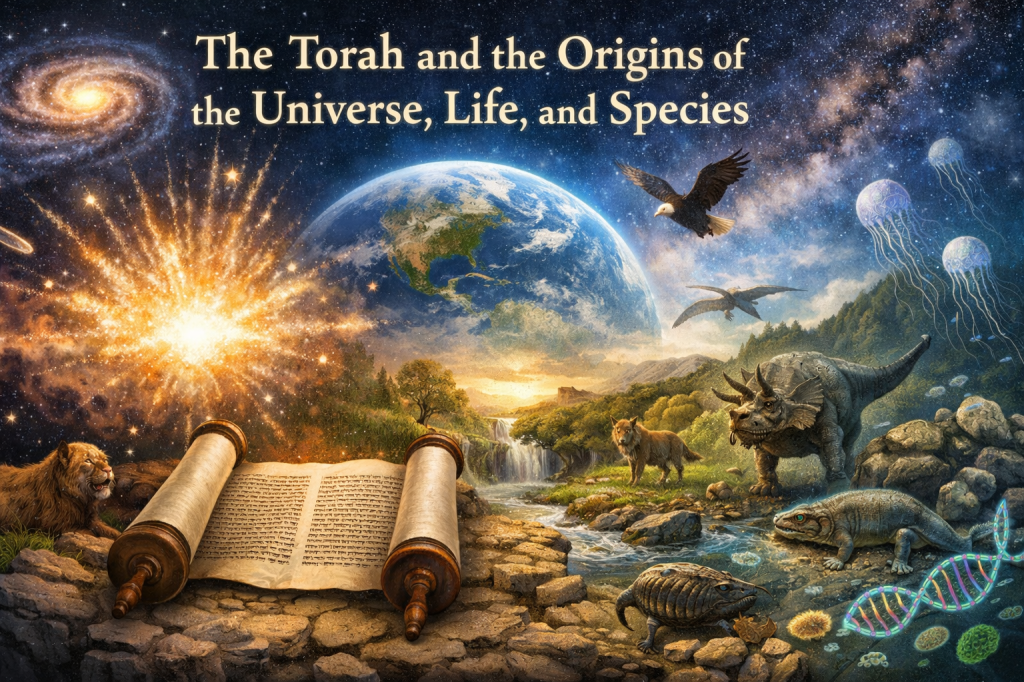
The cornerstone of Judaism is the Torah; unfortunately, this seminal text provides zero explicit mentions of three pertinent scientific theories: the Big Bang, evolution, and abiogenesis*. As someone who studies the Torah during school hours and is rapt by both Jewish theology and modern science, I find this conundrum quite striking. In examining the Torah, it becomes clear that there is room open for interpretation, and, ultimately, debate.
The very first verse of the Torah reads: “In the beginning God created the heavens and the earth” (Genesis 1:1). As a theological claim, this could be interpreted as aligning with the concept of the Big Bang; however, this verse does not adress the processes by which the event would occur.
Indeed, the Torah contains no mention of redshifting, the cosmic microwave background, primordial hydrogen and helium ratios, or any other features by which we can be certain in some form of a rapid expansion.
Within the three Abrahamic religions, three main positions exist regarding the Big Bang.
The middle-ground approach is Old-Earth Creationism. Old-Earth Creationists constitute most Orthodox Jews, but not most Jews in total. They accept that the universe is as old as science indicates, but believe God performs the major acts of creation, with evolution functioning only in minor ways.
The religious fundamentalist approach is Young-Earth Creationism. Young-Earth Creationists, primarily Haredi, reject the Big Bang, believe the world is roughly 10,000 years old, and interpret the Torah literally.
The approach most in tune with modern science, but still religious in nature, is Evolutionary Creationism. Evolutionary Creationists fully accept the Big Bang, see evolution as divinely guided, and interpret the Genesis account largely as symbolic.
Whichever group you belong to, however, the same uncomfortable truth remains: the Torah itself remains silent on the mechanisms of our cosmic origin.
—
Regarding biological evolution, the pattern persists: the Torah contains no explicit mention of common descent, mutation, or natural selection; however, some verses could be interpreted as alluding to evolutionary processes. For example, Genesis 1:11–12 states: “Let the earth bring forth vegetation,” and Genesis 1:20–25 describes animals being created “according to their kinds” (l’minéhem). These passages depict creation as discrete and divinely commanded, rather than gradual and grueling.
Evolutionary Creationists reconcile evolution with the Torah by interpreting each day of creation as an epoch, allowing time for evolutionary processes. Still, the Torah does not provide any scientific framework: there is no reference to genetic nested hierarchies, endogenous retroviruses, DNA similarities, or fossil evidence. Its silence leaves both the occurrence and the mechanisms of evolution open to interpretation.
—
Finally, the question of abiogenesis, which refers to the origin of life from non-living matter, presents a similar tension.
The leading scientific framework proposes that early Earth, rich in water, simple chemicals, and energy sources such as heat, lightning, and ultraviolet radiation, produced organic molecules naturally. Then, over the course of epochs, some of these molecules self-assembled into primitive structures. After, a molecule which was capable of both storing information and replicating itself (e.g. RNA) eventually emerged.
This first self-replicating system marks the origin of life, after which natural selection could operate. Of course, the exact steps remain uncertain, and probability estimates are dubious due to unknown initial conditions. Still, this framework remains the most coherent scientific account currently available as to how the first life form appeared. The Torah, as with the Big Bang and evolution, provides no explicit discussion of this process, leaving its occurrence and the reasons behind it open to discussion.
In conclusion, the Torah consistently lacks mechanistic explanations of cosmic, biological, or chemical origins; its silence on the Big Bang, evolution, and abiogenesis invites interpretation rather than dictates scientific fact. For students and scholars alike, this dual engagement, immersed in both the sacred text and modern science, creates space for rigorous debate, nuanced understanding, and the ongoing search for coherence between the opposite forces of faith and reason.
*abiogenesis refers to the origins of life from non-life



 The Valley Torah Scroll
Leave a comment