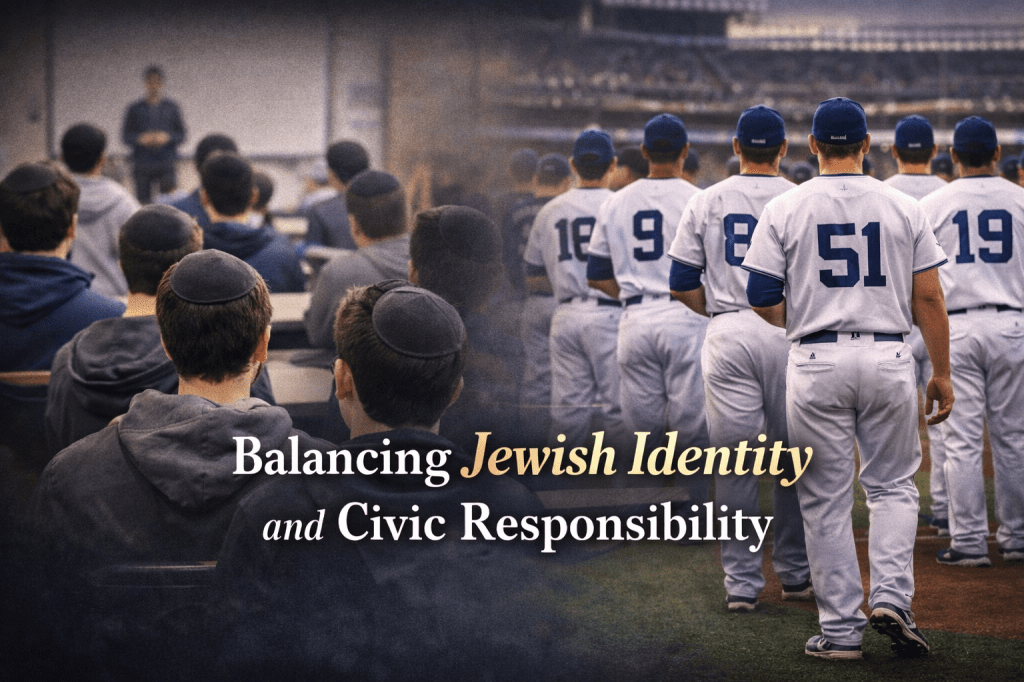
Every Friday, Rabbi Stulberger, our school principal, delivers a speech pertaining to the parasha, (portion of weekly torah reading) which he calls the “Shmuz.” Students receive life guidance, d’var torah, (lit. “word of torah) and engage with the sacred text. As a member of the baseball team, I feel it would be appropriate to contrast that picture with a major league baseball game. Before every professional baseball game, the National Anthem is played. This situation underlines a troubling conflict many religious schools in secular countries* are confronted with: how can a Jewish school balance Jewish responsibility with civic duty? This conundrum, as it pertains to the National Anthem, is quite striking.
First, the constitutional framework. The First Amendment to the United States Constitution protects both freedom of speech and freedom from compelled speech. The Supreme Court made this explicit in West Virginia State Board of Education v. Barnette, holding that students cannot be forced to salute the flag or recite the Pledge. That principle is non-negotiable; however, there is a difference between compulsion and availability. In a public school, the state may not coerce participation, but they may provide the opportunity for those who do wish to participate. Playing the anthem does not violate the Constitution; forcing participation would.
Second, the halachic frame. Jewish law recognizes the doctrine of dina d’malchuta dina — the law of the land is binding. Throughout exile, Jewish communities have generally adopted a posture of civic loyalty toward host nations, so long as core religious obligations were not compromised. At the same time, Jewish thought places limits on nationalism. Ultimate sovereignty belongs to God, not the state. The anthem cannot become an object of reverence. But civic gratitude and theological loyalty are not the same category. One is political; the other is sacred.
Before acting, we should gather data, as a serious decision requires evidence, not assumption. A school survey could ask:
- Should the anthem be played at major school events?
- Should standing be voluntary?
- Would playing it strengthen or weaken school unity?
- Does it conflict with Jewish identity?
- How strongly do you feel (1–5)?
- Break responses down by grade level. Seniors may think differently than freshmen. If we claim to represent the student body, we should actually measure it.
The counterarguments deserve engagement as well. Some will argue it politicizes school space. Others will say Jewish identity must remain primary. Some will worry about alienating dissenters. These concerns are legitimate, but manageable as well. For example, voluntary standing addresses coercion. Limited frequency (once per month or at major events) avoids ritual inflation. Administrative framing can clarify: this is civic respect, not ideological conformity.
Are we cultivating insular students who reject social integration or informed citizens capable of balancing their particular identity with civic responsibility?
*secular countries = in this context, defined as a country in which the government does not legislate religion

 The Valley Torah Scroll
Leave a comment